7 Things a Best HWID Spoofer Guide Must Cover Before You Buy One
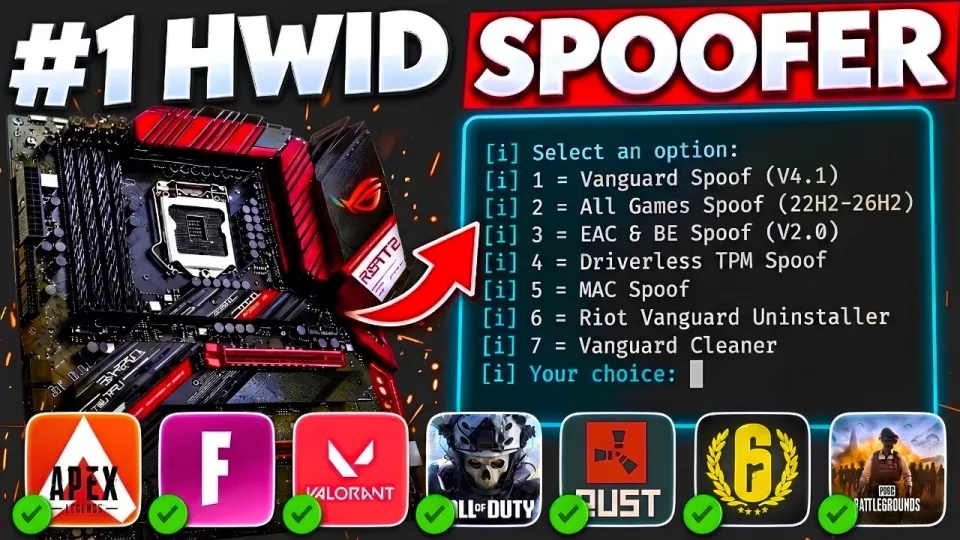
Video: HWID Spoofer Full Guide: How To Get Unbanned From Any Game Fast! (Best HWID Spoofer)
A best HWID spoofer is a tool that changes the hardware identifiers an anti-cheat reads — disk serials, motherboard and SMBIOS strings, MAC addresses, volume IDs — so a banned machine looks like a different one. The Zaliant permanent spoofer, sold through their product page, is marketed as an undetected solution with TPM bypass for Valorant bans, support for all motherboards and no Windows reinstall. This guide explains what these claims mean in practice and what to verify before you pay.
How hardware bans actually work in 2026
A hardware ban is a fingerprint ban: the game's anti-cheat hashes identifiers collected from your PC and refuses to run when the hash matches a flagged record. The most common sources are the system drive serial number, the motherboard and BIOS strings exposed through SMBIOS, the Windows volume ID, the machine GUID, network adapter MAC addresses, and — on newer systems — the TPM module that stores platform keys. Because the ban lives on the machine rather than the account, creating a fresh account, reinstalling Windows or formatting the drive usually changes nothing: the same serial numbers come back after a clean install.
That is the gap spoofers fill. A spoofer intercepts or rewrites those values at the level the anti-cheat queries them, so the collected fingerprint no longer matches the ban record. Coverage matters more than speed: a tool that changes the disk serial but leaves the SMBIOS table and TPM intact will be re-flagged on the next scan.
What the Zaliant permanent spoofer claims to do
The vendor positions its product as a permanent spoofer — a one-time application that persists across reboots rather than a temporary session spoof. The published feature list includes TPM bypass for Valorant hardware bans, compatibility with all motherboards, no Windows reset required, constant updates, fast support and a customer base stated as 3,000+ satisfied users. Access is distributed through the Zaliant store and a Discord community where updates and support requests are handled.
The TPM point is the one worth understanding. Valorant's anti-cheat (Vanguard) can tie a ban to TPM-backed platform data, so a spoofer that only touches disk and SMBIOS values may not be enough on machines with TPM 2.0 enabled. A claimed TPM bypass means the tool also addresses that layer — ask the vendor directly which TPM states (enabled, disabled, cleared) are supported on your board before purchasing.
What to check before you buy any spoofer
- Game coverage. Confirm the tool explicitly lists the titles you need — Valorant, Fortnite, Rust, Apex Legends, Call of Duty or FiveM servers each read different identifiers.
- Motherboard support. "All motherboards" is a broad claim; verify your chipset and whether the vendor has tested your model.
- TPM handling. If you play Valorant, ask whether TPM bypass is included or sold separately.
- Reboot behaviour. A permanent spoof should survive restarts; a temporary one resets and must be reapplied.
- Update cadence. Anti-cheat updates break spoofers regularly; check how recently the tool was patched.
- Support channel. A Discord with active staff is a better signal than an email form alone.
- Payment and refund terms. Know what happens if the tool does not work on your hardware.
Free spoofers versus paid tools
Search volume around "free hwid spoofer" is enormous, and that is exactly why free builds are risky. Public spoofers are downloaded by thousands of users, which makes their signatures easy for anti-cheat vendors to detect and block; many are also bundled with malware or steal credentials. A paid tool has a smaller distribution and a vendor with an incentive to patch it after each anti-cheat update. That does not make every paid product safe — it means the risk shifts from malware to detection and support quality, which you can evaluate before buying.
How a spoofer is typically applied
The workflow described by most vendors, including Zaliant, follows the same pattern: purchase and receive access, download the loader, disable antivirus interference for the installation, run the spoofer as administrator, let it rewrite the identifiers, then reboot. After the restart the machine presents new hardware values and the game can be launched on a fresh account. Two rules decide whether the unban holds: never log back into the banned account, and do not reinstall the same cheat that caused the ban — a spoof hides the hardware, not the behaviour that triggered the original detection.
Risks, limits and realistic expectations
A spoofer is a cat-and-mouse tool. Anti-cheat developers add new identifier sources over time, so a permanent spoof can become detectable after a major update and require a patch. Spoofing also touches low-level system components, which can destabilise Windows or conflict with drivers, and some tools leave traces that a full anti-cheat scan may pick up later. Finally, using a spoofer to evade a ban generally violates the game's terms of service, and a repeat detection can result in a new ban on the spoofed fingerprint — this time with no clean hardware left to fall back on.
All links from the breakdown
- Permanent spoofer product page: https://www.zaliantservices.com/products/permanentspoofer
- Zaliant store: https://www.zaliantservices.com
- Discord community: https://discord.gg/zaliant
Summary
The best HWID spoofer for your case is the one that covers every identifier your game's anti-cheat reads — including TPM data for Valorant — survives reboots, and gets patched quickly when detection changes. Zaliant's permanent spoofer claims exactly that combination: TPM bypass, all-motherboard support, no Windows reset and 3,000+ customers, distributed through its store and Discord. Verify your motherboard and game list with support before paying, and remember that a spoof resets your hardware identity, not the account or cheat that caused the ban. This breakdown was prepared by the 芸芸记录生活 channel; for the current build, start at the permanent spoofer page.
Key takeaways
- A hardware ban blocks the machine, not just the account, so a new account alone will not restore access.
- Zaliant's permanent spoofer is sold at $zaliant and advertised with TPM bypass for Valorant hardware bans.
- The vendor claims 3,000+ satisfied customers and says no Windows reset is required.
- Spoofers target identifiers such as disk serials, SMBIOS data, MAC addresses and volume IDs.
- Anti-cheat systems can re-flag a machine if the spoof is partial or the cheat is reused afterward.
Source: HWID Spoofer Full Guide: How To Get Unbanned From Any Game Fast! (Best HWID Spoofer) · Markdown version
Questions & answers
Does an HWID spoofer really get you unbanned from Valorant?
A spoofer changes the hardware identifiers Vanguard uses to recognise a banned machine, so the game can run again on a new account. It does not unban the original account, and the spoof must cover TPM data as well as disk and SMBIOS values, which is why TPM bypass is advertised as a separate feature.
Is a free HWID spoofer safe to use?
Public free spoofers are widely distributed, so their signatures are quickly detected and blocked, and many builds carry malware. A paid tool with regular updates and active support carries a different risk profile — detection and support quality rather than malicious code — but no spoofer is risk-free.
Do I need to reinstall Windows after spoofing?
No. Zaliant states that no Windows reset is required: you run the tool, reboot, and the machine presents new hardware values. A full reinstall would not help anyway, since the banned serial numbers return with a clean installation.
Can I get banned again after using a spoofer?
Yes. If the spoof is incomplete or you reuse the same cheat, the anti-cheat can flag the new fingerprint and issue another ban. Spoofers hide hardware identity, not the behaviour that triggered the original detection, and using one generally violates the game's terms of service.